Protecting a fragile ecosystem by creating local value
On the outskirts of Niokolo-Koba National Park (PNNK), an exceptional yet fragile ecosystem listed as a UNESCO World Heritage Site, the Api-Niokolo project demonstrates that it is possible to reconcile nature conservation with local economic development.
Supported by the Foundation since 2023, the project is part of the Belgian cooperation’s 2022–2026 five-year program dedicated to sustainable food systems. Its ambition is clear: to reduce pressure on the park’s natural resources by developing income-generating activities designed to last.
In this region, traditional wild honey harvesting can lead to bushfires and weaken ecosystems. By structuring a modern beekeeping sector, Api-Niokolo offers a concrete alternative that is environmentally friendly and economically viable for neighboring villages.
Concrete progress in the field
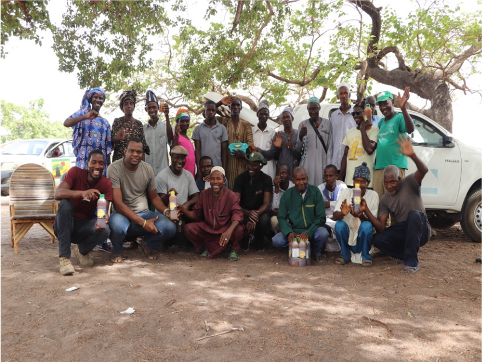
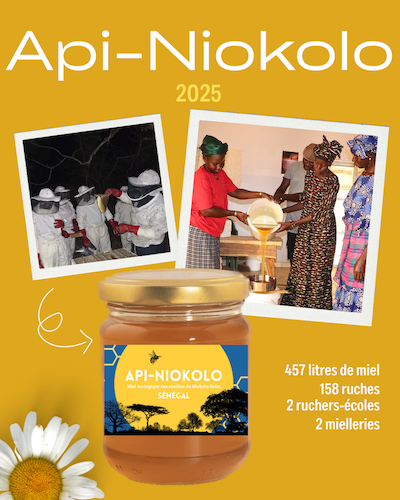
After an initial phase focused on infrastructure development, 2025 marked an important stage of consolidation. Two training apiaries and two honey-processing facilities are now operational in Linkéring (Kalifourou) and Niéméniké. In total, 158 hives were installed and 457 liters of honey were harvested in 2025.
Beyond the figures, a strong local dynamic is emerging: honey quality is improving, practices are advancing, and colony losses are decreasing thanks to regular technical support. Training in modern beekeeping, as well as carpentry for hive construction and repair, is strengthening the autonomy of beekeepers and trained youth.
Exchanges between villages encourage knowledge sharing and collective skill development. Youth engagement is strong, and women’s participation is increasing, particularly in organizational and administrative roles, helping to sustainably structure the sector.
Floral resource inventories conducted around the park have revealed remarkable biodiversity, with nearly 100 plant species identified. This potential provides a solid foundation for the development of high-quality beekeeping.
At the same time, the reduction in fires linked to traditional harvesting methods shows a tangible environmental impact. Api-Niokolo is thus helping to strengthen the positive relationship between human activities and biodiversity conservation.
A new ambitious phase: Api-Niokolo II
Building on the achievements of the first years, the project is entering a new phase (2026–2028) aimed at expanding this dynamic to other communities bordering the park. The objective is to strengthen the governance of beekeeper groups, develop environmental education initiatives for schools and local communities, and reinforce social cohesion around a sustainable and equitable sector.
This phase also includes the creation of the Niokolo-Base, an innovative documentation tool designed to centralize, archive, and sustainably share scientific, technical, and educational knowledge related to the park. Knowledge capitalization thus becomes a strategic lever for guiding future conservation actions.
Designed as a long-term initiative, Api-Niokolo aims to make honey a true source of added value for the region, serving both biodiversity and local development.